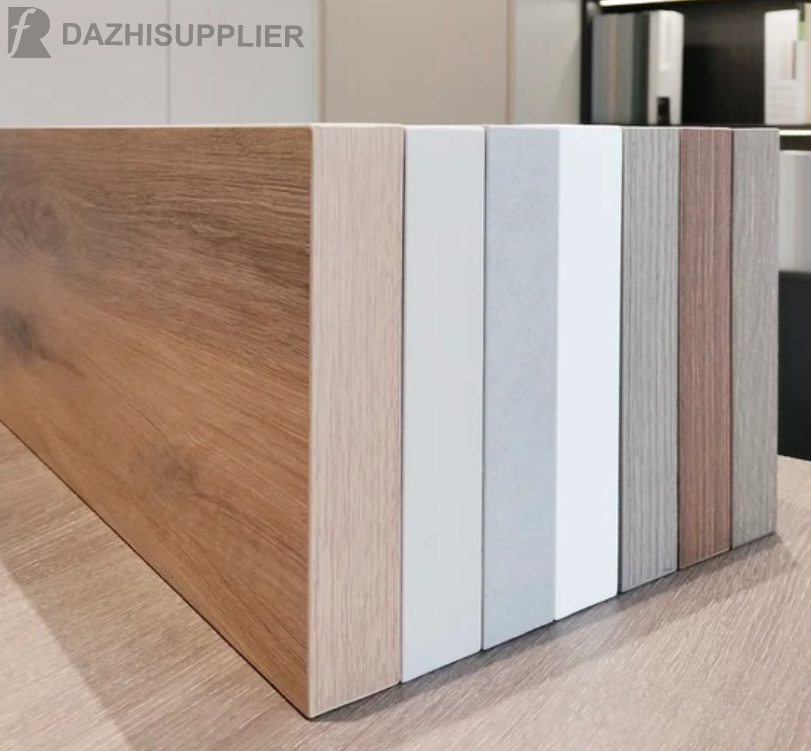
When customizing cabinets, few people think to ask: "How thick are your cabinet boards?"
But that 2mm difference directly determines whether your cabinets last 5 years or 15 years.
Let's break it down.
18mm Boards
Strong load-bearing capacity – shelves won't sag under heavy items
Better screw-holding power – hardware stays tight
More stable structure – cabinet body resists warping
The standard configuration for most mainstream custom brands
16mm Boards
Lower cost – commonly found in budget packages
Average load-bearing – sags over time under heavy loads
Weaker screw-holding – hinge screws loosen easily
Typically used for back panels and drawer bottoms (non-load-bearing parts)
Shelf Load-Bearing: An 18mm shelf loaded with books or cookware stays flat after a year. A 16mm shelf under the same load may visibly sag within six months.
Hardware Lifespan: Hinges are screwed into the board. 18mm boards hold screws tighter – doors stay secure after tens of thousands of open-close cycles. 16mm boards loosen easily, leading to sagging doors that won't close properly.
Cabinet Stability: The taller and wider the cabinet, the more board thickness matters. 18mm cabinets are more rigid overall – less shaking and rattling.
| Part | Recommended Thickness | Why |
|---|---|---|
| Shelves | 18mm | Direct load-bearing – no compromise |
| Vertical panels (sides) | 18mm | Determines overall rigidity |
| Top / bottom panels | 18mm | Structural support – affects stability |
| Back panel | 5-9mm | Not load-bearing, but too thin means moisture damage |
| Drawer bottom | 5-9mm | Light load – can be thinner |
A common budget-package trick: The quote only says "particleboard" without mentioning thickness. After signing, you discover the cabinet body uses 16mm boards – shelves are already sagging, and hardware is loosening.
Before signing, confirm:
Are shelves, vertical panels, and top/bottom panels all 18mm?
What's the back panel thickness? (9mm or above recommended)
Is the board thickness written into the contract – not just "particleboard"?
2mm may not sound like much, but when it comes to load-bearing, hardware lifespan, and cabinet stability, the difference is very real.
As a one-stop whole-house customization service provider, we use 18mm boards for all shelves, vertical panels, and top/bottom panels, with 9mm back panels as standard. Thickness is clearly stated in the contract – so you never lose out on what you can't see.
Planning a custom project? Contact us for a free on-site measurement and a transparent, detailed configuration list.
Contact: Cherry Fang
Phone: +86 136 2007 7702
E-mail: info@dazhisupplier.com
Whatsapp:8613620077702
Add: 748 Houjie Town, Dongguan City, China, 523000
We chat