When choosing cabinets, most people focus on whether the boards are eco-friendly or if the color looks good – but they overlook a detail that truly determines how many years your cabinets will last: edge banding.
Poor edge banding means your cabinets will start peeling, swelling from moisture, and turning black at the edges within a year or two. Let's break it down in one article.
After boards are cut, the cross-sections are exposed. Edge banding is the process of sealing those exposed edges with a banding strip. Its purposes are:
Moisture protection: Prevents water vapor from seeping into the board's core
Formaldehyde containment: Seals the board to reduce harmful emissions
Aesthetics: Covers the rough, exposed cross-section
Impact protection: Protects edges from chipping and damage
In short: Edge banding is your cabinet's "waterproof layer" and "protective shell."
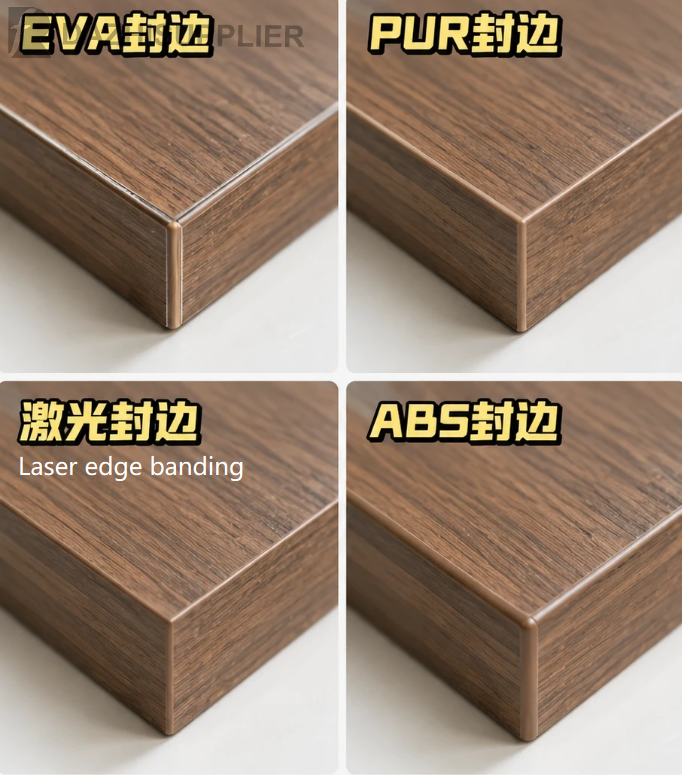
How it works: EVA hot-melt glue is heated to bond the edge banding strip
Pros: Low cost, simple process
Cons: Heavy glue usage, visible glue lines; prone to peeling and detaching when exposed to moisture or heat; poor waterproofing
Best for: Cabinets in dry areas, when budget is extremely tight
How it works: PUR polyurethane hot-melt glue cures by reacting with moisture in the air
Pros: Uses only 1/3 the glue of EVA, finer glue lines; significantly better waterproofing and heat resistance; resists detachment
Cons: Costs more than EVA, requires professional equipment
Best for: Kitchens, bathrooms, balconies, and most household cabinets
How it works: The banding strip has a functional layer on its back that melts instantly under laser and fuses with the board – virtually no glue needed
Pros: Seamless, no glue lines, the most aesthetic option; strongest waterproofing; most durable
Cons: Highest cost, limited color options for banding strips
Best for: Clients with ample budget and the highest demands for both looks and durability
| Factor | EVA | PUR | Laser |
|---|---|---|---|
| Glue Usage | High | Medium | Virtually none |
| Glue Lines | Visible | Fine | Seamless |
| Waterproofing | Poor | Good | Best |
| Durability | Peels easily | Resists detachment | Most durable |
| Cost | Low | Medium | High |
| Recommended For | Dry areas | Kitchens/balconies/most cabinets | High-demand clients with budget |
Try prying it with your finger: Run your finger along the edge and pry gently – poor-quality banding will lift easily
Check the glue line: Hold it up to the light and look at the seam between banding and board – the finer the line, the better. Laser banding is virtually invisible
Check color match: The banding strip should closely match the board color. Obvious color differences look cheap
The board determines the floor of your cabinet's quality; the edge banding determines the ceiling.
The same board with different edge banding methods can differ by years in lifespan. Before signing a contract, always ask: Which edge banding method do you use? If the salesperson is vague, be cautious.
In our one-stop customization service, kitchen and balcony cabinets come with PUR edge banding by default, with laser edge banding available for clients with higher requirements – ensuring your cabinets last longer and give you peace of mind from the very start.
Planning a custom project? Contact us for a personalized cabinet solution for your home.
Contact: Cherry Fang
Phone: +86 136 2007 7702
E-mail: info@dazhisupplier.com
Whatsapp:8613620077702
Add: 748 Houjie Town, Dongguan City, China, 523000
We chat